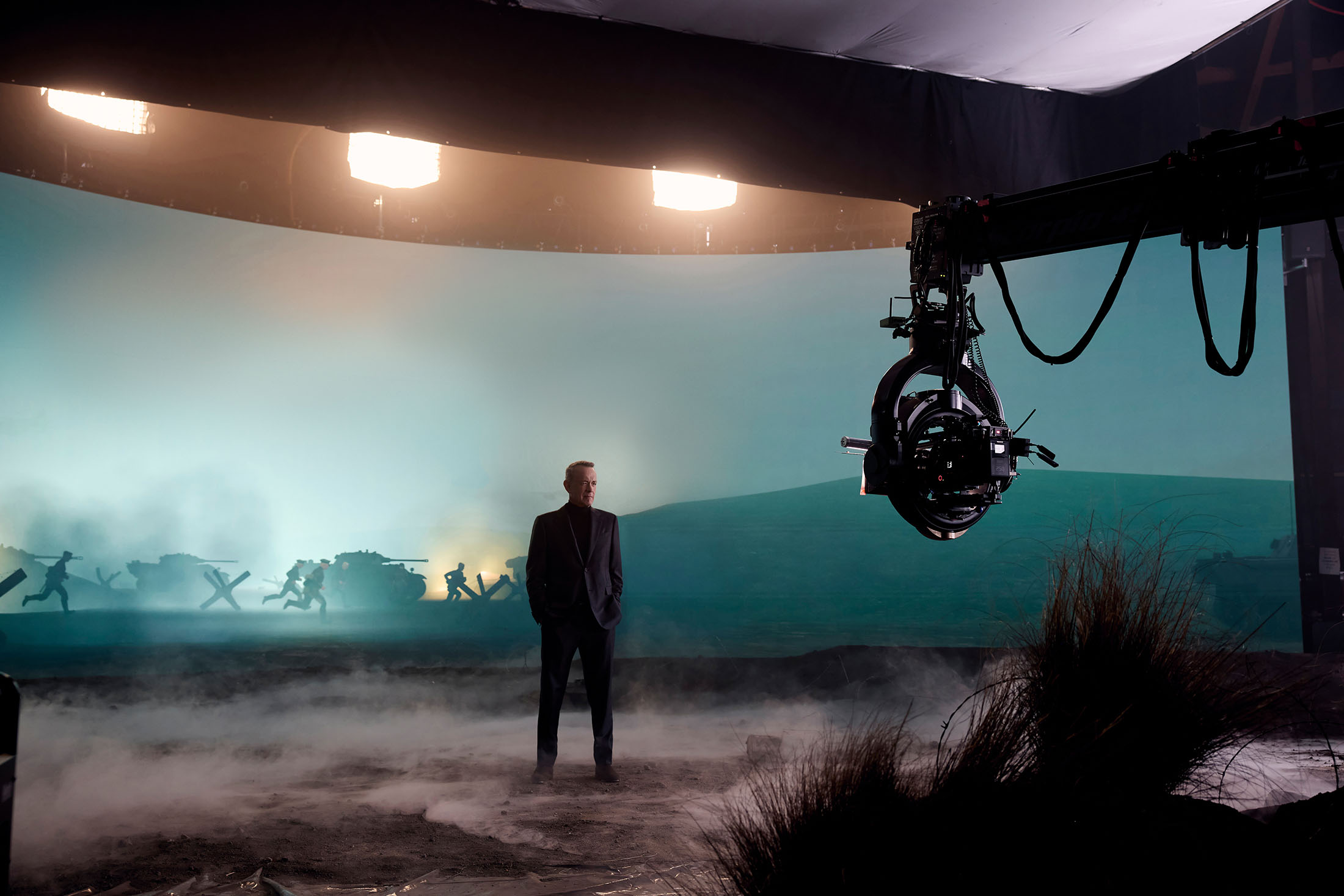
HISTORY premieres “WORLD WAR II WITH TOM HANKS” globally and simultaneously next Monday, May 25 — a 20-episode documentary series that will air in 200 territories and 40 languages, kicking off an unprecedented television event that re-examines the most devastating conflict of the 20th century from a contemporary, human, and remarkably in-depth perspective.
The result of more than ten years of work, the series presents a monumental reconstruction built from real archival material, much of it never before seen publicly, featuring restored footage, previously unreleased records, and recovered historical audio that bring the war back to life with a level of intimacy and power rarely achieved on screen. With no fictional recreations, the production connects footage filmed during the conflict itself with expert testimony, building a narrative that seeks to convey the true human, political, and military scale of World War II.
Tom Hanks runs through the entire series as its throughline, serving as host and narrator as well as producer. His connection to this period is rooted in a career deeply tied to its on-screen portrayal, through landmark productions such as Saving Private Ryan (1998), Band of Brothers (2001), The Pacific (2010), Greyhound (2020), and Masters of the Air (2024).
Hanks explains that there’s an enormous amount of material that has never been seen before — not just new scenes, but literally new footage on film, new images, and material that is far more deeply integrated into the context of its time. He states that this is a form of visual storytelling that no longer just tells, but now shows what happened, calling that shift immense.
“WORLD WAR II WITH TOM HANKS” covers the global conflict in its full scope, from the rise of Nazism and Japanese expansionism to the fall of the Axis powers and the emergence of the new world order after 1945, tracing some of the war’s most decisive episodes: the invasion of Poland, the fall of France, the evacuation of Dunkirk, the Blitz on Britain, Operation Barbarossa, Pearl Harbor, the Guadalcanal campaign, Stalingrad, D-Day and the invasion of Normandy, the final push on Berlin, and the nuclear outcome at Hiroshima and Nagasaki. The series portrays the violence of combat waged on land, sea, and air — from the Atlantic and the Mediterranean to Eastern Europe and the jungles of the Pacific — while also delving into less-explored aspects, such as tensions within Allied command, the role of propaganda, intelligence and espionage operations, clandestine resistance, submarine warfare, and the enormous industrial and technological power that ultimately tipped the balance of the conflict and redefined the 20th century.
The production explores the human cost of total war, including the Holocaust, civilian resistance, and the bombing of cities, as well as the psychological and everyday impact that forever changed the lives of millions of people around the world.
Throughout, the series weaves together the strategic decisions of central figures of the era — including Winston Churchill, Franklin D. Roosevelt, Joseph Stalin, Adolf Hitler, Dwight D. Eisenhower, Erwin Rommel, and Hideki Tojo — with the experiences of soldiers and civilians across different continents, building a narrative that connects the conflict’s geopolitical scale with its deeply human dimension.
Historical contributors to the series include Tessa Dunlop, Saul David, James Bulgin, Antony Beevor, Dan Snow, Guy Walters, and Simon Sebag Montefiore, among other international specialists. Key figures who provide military, political, and historiographical context also appear throughout the episodes, including Pulitzer Prize–winning historian Jon Meacham, Robert Citino, Phillips O’Brien, Geoffrey Wawro, Rebecca Grant, Alexandra Richie, Doug Douds, Albert J. Baime, Dan Carlin, Wesley Clark, Jonathan Parshall, Michael Neiberg, Waitman Beorn, and Jadwiga Biskupska, among other experts who help reconstruct in depth the strategic decisions, the development of the campaigns, and the human impact of the conflict on every front.
Executive produced by Tom Hanks and Gary Goetzman, alongside Nutopia and A+E Factual Studios Group, the series delves into the moment the world entered total war without yet knowing its outcome. Hanks reflects that when he was a kid, every adult who looked after him had a view of the war similar to how someone might talk about a great plague or a great flood — their lives divided into three parts: before the war, after the war, and during the war. He adds that this generation lived through years of absolute uncertainty, where time seemed suspended and the future was impossible to predict.
In Hanks’s own words, the goal of revisiting this period isn’t to repeat what’s already known, but to understand it from new perspectives. He states that the main reason to look at this again is the example set by the people who lived through that moment, explaining that the only way to know who we are lies in our behavior, and that’s where the importance of studying the example of World War II lies. He adds that the world is a better place when all its citizens are regarded as holders of certain inalienable rights — the idea that guided half the world in standing up to those who sought to impose domination and strip away basic freedoms.
World War II was the largest and deadliest conflict in human history: more than 50 nations took part in a war fought on land, sea, and air, spanning nearly every continent. Its origins trace back to the economic crisis of the Great Depression and the unresolved political tensions left after World War I by the Treaty of Versailles, which further destabilized the international order.
The conflict broke out on September 1, 1939, with Nazi Germany’s invasion of Poland, and rapidly expanded into a global war that lasted six years. It came to an end on September 2, 1945, with Japan’s surrender following the atomic bombings of Hiroshima and Nagasaki, marking the definitive close of the conflict.
During that period, the world witnessed unprecedented destruction: an estimated 60 to 80 million people died, including as many as 55 million civilians, while entire cities across Europe and Asia were reduced to rubble. Among the victims were 6 million Jews murdered in Nazi concentration camps during the Holocaust, the brutal genocide carried out by Adolf Hitler’s regime.
The end of the war not only redrew political borders but opened a new chapter in contemporary history: the creation of the United Nations as an international peacekeeping body, and the start of a new global order marked by geopolitical rivalries that would give rise to the Cold War.
From Nazi expansion to the war’s first turning point: the world enters the conflict that redefines the 20th century
HISTORY will air this 20-episode television event in two parts: a first batch of eight episodes, from Monday, May 25 through the start of the FIFA World Cup, and a second block beginning once the tournament concludes.
In the first part, “WORLD WAR II WITH TOM HANKS” reconstructs the outbreak and early expansion of the conflict as a turning point that redefines the balance of the planet, showing how a series of specific political and military decisions ends up completely transforming the global order and the lives of millions of people.
The story begins with the rise of Adolf Hitler and the consolidation of the Nazi regime, against a backdrop of deep unrest in postwar Germany following World War I and the Treaty of Versailles, which left the country in a state of crisis and humiliation. A veteran of that earlier conflict, Hitler channels this climate of discontent into his political project, bolstered by his powerful skills as an orator and communicator, which he had already honed during his time in prison following the failed Munich coup attempt — where he also wrote Mein Kampf, the key text of his ideology. Along the way, antisemitism gradually becomes state policy.
From the Nuremberg Laws and the stripping of rights from the Jewish population to events like Kristallnacht and the creation of ghettos in Poland following the 1939 invasion, the series reconstructs the advance of a system of persecution, violence, and control that expands in step with the war.
Alongside the development of the conflict on the European front, the production also examines how the political crisis of the 1940s reshapes leadership in the United Kingdom: amid growing tension with Germany, Prime Minister Neville Chamberlain — associated with a more conciliatory stance toward Hitler — is ultimately replaced following his resignation, giving way to Winston Churchill, whose rise to power marks a shift toward firmer, more decisive leadership within the Allied resistance.
Starting with the invasion of the Soviet Union, the series shows a decisive turning point: the war stops being purely military and becomes an ideological war of extermination. In the East, the German advance unleashes unprecedented violence, with mass shootings carried out by mobile units operating behind the front lines. That process feeds into an increasingly systematic logic that culminates in the so-called “Final Solution,” where death becomes industrialized in camps specifically designed for mass murder.
Meanwhile, the conflict takes on a truly global dimension. In Asia, Japan carries out a lightning-fast expansion across China and Southeast Asia, until the attack on Pearl Harbor draws the United States into the war. That blow reshapes the global balance of power and opens two decisive fronts: the Pacific, with grueling battles of attrition on islands like Guadalcanal, and the Atlantic, where the fight for naval control becomes vital to Allied survival.
In Europe and North Africa, the narrative expands into a new strategic theater. Operation Torch marks the first major joint ground offensive by the United States and Britain, under the still-untested command of Dwight D. Eisenhower. What looks like a complex but manageable landing quickly becomes a trial by fire: clashes with Vichy French forces, unexpected political negotiations, and, eventually, direct combat with German and Italian troops. At the same time, the desert war reaches its turning point with the offensive and counteroffensive between Montgomery and Rommel, setting the stage for the Allied counterattack and the gradual Axis retreat in North Africa, culminating in their final defeat in the Tunisia campaign.
This first part offers a sweeping, sustained portrait of how, between 1939 and 1943, the world moves from a European war to a total global conflict — a process in which military strategy, international politics, and industrialized violence intertwine to redefine the 20th century, as the Allies slowly begin to reverse the Axis advance and pave the way toward its defeat.
From Stalingrad and Normandy to the collapse of the Third Reich and the dawn of the nuclear age
In the second batch of episodes, “WORLD WAR II WITH TOM HANKS” delves into the most decisive and devastating period of the conflict, as the war enters a phase of total attrition and the Allies slowly begin to tip the balance in their favor. The series reconstructs the secret war waged in the shadows through espionage, cryptography, and intelligence operations tied to the Enigma code, while also portraying some of the most brutal and pivotal battles of the entire war, such as Stalingrad, the Italian campaign, the air war over Europe, and the Normandy landings. As the conflict expands, the narrative also delves deeper into clandestine resistance in occupied territories, internal tensions among the Allies, and the immense human toll endured by both soldiers and civilians on every front.
At the same time, the series follows the gradual collapse of the Axis powers and the final stretch of the war in Europe and the Pacific. From the Allied advance on Berlin and the final days of the Third Reich to the extreme violence of the campaign against Japan, the episodes show how the conflict reaches unprecedented levels of destruction and desperation. The development of the atomic bomb and the attacks on Hiroshima and Nagasaki in August 1945 emerge as the culminating point of a war that forever transforms contemporary history and ushers in a new era defined by nuclear balance and the onset of the Cold War. Beyond the military operations, the production once again turns its focus to the human, political, and moral consequences of a conflict whose impact continues to shape the world today.
“WORLD WAR II WITH TOM HANKS” is produced for HISTORY by Nutopia and A+E Factual Studios Group, in partnership with Motion Entertainment, a WPP Media company, with Tom Hanks and Gary Goetzman serving as executive producers, alongside Jon Meacham, Ben Goold, Jane Root, and Steve Condie, among others. Produced in collaboration with The National WWII Museum in New Orleans.
SYNOPSIS — “WORLD WAR II WITH TOM HANKS”
THE BEGINNING (#01)
MONDAY, MAY 25
In September 1939, the German invasion of Poland shatters the fragile balance holding Europe together and triggers the most devastating military conflict of the entire 20th century. As the Western powers respond, the world enters a total war of global scale.
BLITZ (#02)
MONDAY, MAY 25
After crushing the Netherlands and Belgium, Nazi Germany pushes forcefully toward the heart of France. As the British army holds on as best it can, Churchill must defend the skies of the United Kingdom from bombing raids, while Roosevelt accelerates the industrial and military mobilization of the United States.
BARBAROSSA (#03)
MONDAY, JUNE 1
Operation Barbarossa, launched in 1941, is the largest surprise invasion in history. Millions of German soldiers advance on the Soviet Union in a colossal offensive that soon becomes the costliest and most brutal land campaign ever recorded.
PEARL HARBOR (#04)
MONDAY, JUNE 1
Japan escalates its war in China, drawing increasingly harsh economic sanctions from the United States. Choked by a lack of resources, it decides to attack Pearl Harbor, a bold strike that completely transforms the course and scale of World War II.
THE WAR AT SEA (#06)
MONDAY, JUNE 8
The United States wages a decisive battle for control of the oceans, facing off against Germany’s fearsome U-boats in the Atlantic and Japan’s powerful navy in the Pacific. The fight for control of the sea lanes proves key to finally tipping the balance of the global conflict.
GUADALCANAL (#07)
MONDAY, JUNE 8
Following the devastating attack on Pearl Harbor, Japanese forces sweep rapidly across Southeast Asia. On the island of Guadalcanal, U.S. Marines are tasked with halting that relentless expansion in an exhausting, bloody campaign that proves decisive for control of the Pacific.
DARKNESS FALLS (#05)
MONDAY, JUNE 15
As Hitler’s control spreads across Europe, his antisemitic ideology translates into systematic persecution. What begins as legalized discrimination and violence culminates in the industrialized genocide that will forever mark human history.
OPERATION TORCH (#08)
MONDAY, JUNE 15
In Operation Torch, the first major joint offensive between the United States and Britain, thousands of inexperienced American soldiers, under the yet-untested command of Eisenhower, face off against the battle-hardened Afrika Korps and the legendary Field Marshal Erwin Rommel in North Africa.