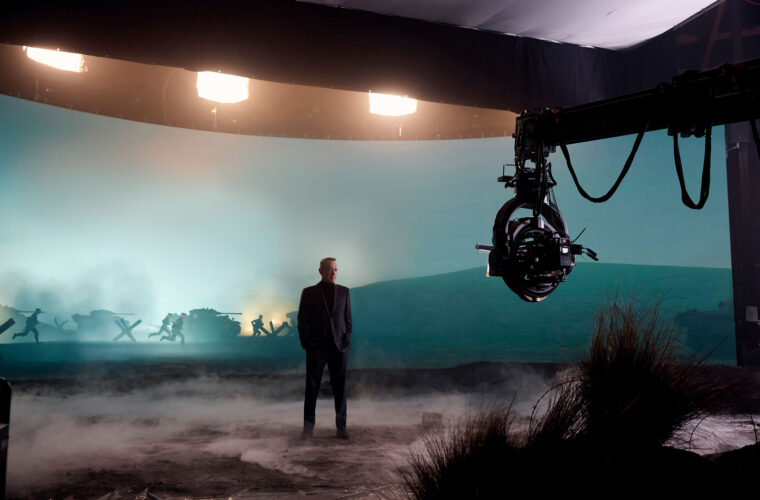
On Friday, June 5, HISTORY premieres the third season of “INDUSTRY GIANTS: MEGA BRANDS,” the hit series from the “Giants” franchise that explores the surprising stories behind some of the world’s most influential and recognizable companies. The production dives into the origins, rivalries, challenges, and innovations that shaped brands that transformed entire industries and left a deep mark on popular culture and the everyday lives of millions of people.
Executive produced by legendary former Indianapolis Colts and Denver Broncos quarterback and five-time MVP Peyton Manning, “INDUSTRY GIANTS: MEGA BRANDS” combines high-production-value dramatic recreations that transport viewers into the heart of each story, along with archival footage and interviews, to portray the rise of corporate giants that forever changed the way we consume, shop, communicate, work, and entertain ourselves. The series follows the stories of visionaries and entrepreneurs who bet on revolutionary ideas, faced failures, took unthinkable risks, and drove fierce competition on their path to success.
Having explored the birth and growth of iconic brands like Walmart, Costco, P&G, UPS, Gillette, American Express, Netflix, Blackberry, Nike, Adidas, and Microsoft, among many others, in previous seasons, this new edition further expands the “INDUSTRY GIANTS: MEGA BRANDS” universe with ten new episodes dedicated to companies that reshaped retail, technology, photography, fashion, home improvement, and mass consumption.
This season spans from the tech race that gave rise to the modern smartphone with Apple and the arrival of the iPhone against BlackBerry, Palm, and Microsoft, to the rise of e-commerce through the rivalry between Amazon and eBay. It also explores the revolution of the modern office driven by Xerox and the leap into personal computing, along with the fierce retail competition between Walmart, Target, and Kmart, which reshaped mass consumption in the United States. Alongside this, it shows the transformation of home improvement and construction with Home Depot and Lowe’s, and the cultural impact of denim with Levi’s and H.D. Lee, which took jeans from workwear to a global icon. The rivalry between Firestone and Goodyear tracks the evolution of the automobile alongside Ford, General Motors, and Chrysler, while the oil crisis marks a turning point for the industry. The season rounds out with the duel between Kodak and Polaroid and the rise of disposable products from Kimberly-Clark, Procter & Gamble, and the Scott brothers, in a story of constant innovation, fierce competition, and global cultural change.
In addition to recreating the major corporate disputes and decisions that redefined multibillion-dollar industries, the series features specialists, business leaders, historians, and notable guest figures who provide context and analysis on the economic, social, and cultural impact of these companies, as well as the strategies and innovations that turned them into true global empires. Featured contributors include Peyton Manning, Eli Manning, Bill Rancic, Adam Richman, and Kevin Smith, along with journalists, analysts, and historians such as Steven Levy, David Pogue, Natalia Mehlman Petrzela, Don Wildman, Bill Carter, Adam Davidson, Romi Mahajan, Kathryn Judge, Michael Porter, Chris Tilly, Kate Murphy, Yohuru Williams, and David Rubenstein, among other experts who enrich the perspective on each story.
Season three opens with the tech race that laid the groundwork for the modern smartphone and culminates in the arrival of the iPhone, the device that forever changed how people communicate, work, consume information, and relate to the world. Through a story marked by failures, risky bets, and corporate rivalries, the episode traces Apple’s early attempts to develop portable digital assistants with the Newton, through the revolution driven by Palm, BlackBerry, and Microsoft in the emerging smartphone market. Alongside this, it shows Steve Jobs’s return to Apple and how his obsession with design, simplicity, and user experience ultimately shaped the iPhone, a product that not only redefined the tech industry but forever changed the daily lives of billions of people.
The series then explores the birth of e-commerce and the fierce competition that gave rise to two of the internet’s most influential platforms: Amazon and eBay. The episode follows Jeff Bezos from his early days as a financial analyst fascinated by the web’s explosive growth, to the creation of Amazon as a small online bookstore destined to become “the everything store.” Alongside this, it reconstructs how Pierre Omidyar revolutionized online sales with a simple auction website that would go on to become eBay. Through corporate rivalries, risky bets, the dot-com boom, and critical moments that put both companies in jeopardy, the episode shows how these brands forever transformed the way people buy, sell, and consume products around the world.
The next episode covers how office work was transformed by the invention of the Xerox photocopier. In a time when administrative tasks were slow, manual, and highly inefficient, a revolutionary idea emerges: a machine capable of duplicating documents quickly and accurately. The story follows Joseph Wilson, who bets the future of his company, Haloid, on Chester Carlson’s invention, giving rise to the Xerox 914. Despite numerous technical obstacles, high costs, and financial risks, the company manages to develop the product and revolutionize the market with an innovative business model: equipment leasing. The photocopier’s massive success forever transforms office dynamics. The episode also shows how Xerox, and later IBM, drive a new technological era that leads to personal computing, including the development of the Xerox Alto, with key innovations such as the graphical interface and the mouse. However, Xerox’s lack of commercial vision allows these ideas to be seized upon by Apple and later IBM, ushering in the personal computer era and the consolidation of the modern digital ecosystem.
To close out June, the series takes a deep dive into the major U.S. home improvement chains, especially Lowe’s and Home Depot, and how they completely reshaped the hardware and construction industry. It all begins with Carl Buchan, who spots the postwar construction boom and suburban expansion. Starting from a family hardware store, he pioneers the “one-stop shop” concept, bringing together everything needed to build or remodel a home under one roof, giving rise to a new retail model. After his death, Lowe’s keeps growing and becomes a regional leader. Meanwhile, Home Depot emerges, founded by Bernie Marcus and Arthur Blank, who take the model even further with warehouse-style stores, aggressive low prices, and high-volume strategies, after overcoming a rocky start with weak sales. Over time, competition between the two companies intensifies, becoming one of the most important rivalries in U.S. retail and redefining the shopping experience in home improvement and construction.
In the fifth episode, the story of denim becomes the definitive rise of jeans as a global cultural garment. Starting with Jacob Davis’s invention of riveted pants and his partnership with Levi Strauss, the iconic 501 model is born, establishing a large-scale denim production industry. While Levi’s builds its dominance from the West, H.D. Lee emerges as a competitor from the East, almost by accident at first, then through key innovations such as overalls, the Union-All work coverall, and, above all, the introduction of the zipper fly for the cowboy market. Competition between the two brands drives a series of technical and design advances that expand denim from rural and industrial work to everyday wear, leisure, and eventually youth fashion. After World War II, film and pop culture — with figures like James Dean and Marlon Brando — cement jeans as a symbol of rebellion, while school bans end up reinforcing their adoption among teenagers. The episode closes with Levi’s reclaiming global leadership and denim becoming an unstoppable cultural and economic phenomenon.
The next episode traces the birth and rise of the great rivalry between Firestone and Goodyear at the dawn of the U.S. auto industry, amid a total restructuring of transportation. As the automobile rises and the carriage era ends, both companies compete to dominate an expanding market, driving key innovations such as inflatable tires, early tread designs, removable tires, and the “spare” tire as a solution to flats. Along the way, the relationship with Henry Ford proves decisive: deals, business betrayals, and strategy shifts shape the fate of Firestone and Goodyear in the Model T era. The story intensifies with World War I, which drives industrial production and positions Goodyear in the airship business, before the postwar period pushes them into a debt crisis. The episode closes by showing how competition between the two brands not only defines the tire business but accelerates innovations like the balloon tire, a precursor to modern design.
The following episode of the season wraps up the Kodak-Polaroid rivalry, showing how the competition that transformed photography ultimately paves the way for its own obsolescence. After decades of cross-innovation — from Kodak’s total dominance in traditional photography to Edwin Land’s instant-photo revolution with Polaroid — the relationship between the two companies shifts from collaboration to open warfare when Kodak decides to break their agreement and compete directly in the instant photography market. Polaroid responds by accelerating innovation with its OneStep camera and the arrival of instant color, while Kodak tries to replicate the model without success and ends up losing ground. Meanwhile, both companies ignore or hold back key developments like digital photography, which ultimately foreshadows their decline. The rise of new technologies like digital cameras and the cultural shift toward total image immediacy leads to the fall of both giants and forever redefines the way memories are captured.
Later on, the series explores the rise of the disposable paper products industry in the United States, driven by changes in daily life, advances in sanitation, and new consumer needs. The episode traces how the Scott brothers popularized modern toilet paper, how Kimberly-Clark reinvented an industrial byproduct into brands like Kleenex after a failed attempt with Kotex, and how Procter & Gamble redefined the market with Charmin and later Pampers. Together, these stories show the consolidation of a key mass-consumption industry built on single-use products.
The second-to-last episode looks at the major U.S. retail chains, tracing the shift from traditional retail toward the “big box store” format. Amid suburbanization, highway expansion, and changing consumer habits, visionaries like Harry Cunningham, Douglas Dayton, and Sam Walton drive new forms of mass retail: Kmart, Target, and Walmart. Each tries to solve the same challenge — offering more variety at lower prices under one roof — sparking fierce competition that reshapes the market. While Kmart initially dominates with aggressive pricing and marketing strategies, Target seeks to differentiate itself with a more aspirational approach, and Walmart builds a key structural advantage by integrating its own distribution and, eventually, the total-supermarket concept with the Supercenter. The episode closes with Walmart’s definitive rise as the global retail leader and Kmart’s gradual decline, while Target manages to carve out an identity between price and style.
Finally, this season closes with the definitive end of America’s golden age of the automobile: from the rise of horsepower and emotion-driven design fueled by competition between General Motors, Ford, and Chrysler, to the structural blow of the 1973 oil crisis that forces a complete overhaul of the industry. After decades of a “horsepower war” between the Corvette, the Mustang, the GTO, and the Thunderbird, the market changes radically with rising fuel prices and the arrival of more efficient foreign competitors. Against this backdrop, the story centers on how Lee Iacocca — first ousted from Ford after the success of the Mustang — resurfaces at Chrysler with an unexpected bet: the minivan, a family-friendly, efficient, and functional vehicle that marks the symbolic end of excess and the beginning of a new industrial logic based on adaptation, family consumption, and fuel efficiency.
“INDUSTRY GIANTS: MEGA BRANDS” is a production for HISTORY by Lucky 8 TV and Omaha Productions, from former football player Peyton Manning. Kim Woodard, Greg Henry, Isaac Holub, George Kralovansky, Shari Ortner, Brian Burstein, and Harry Courniotes serve as executive producers for Lucky 8 TV. Jim Pasquarella and Brandy Crawford-Uriu are executive producers for HISTORY.
EPISODE SYNOPSES — “INDUSTRY GIANTS: MEGA BRANDS”
THE WORLD IN YOUR PALM (#13)
FRIDAY, JUNE 5
Computing giants race to create the first handheld computer. Amid million-dollar failures, unlikely alliances, and the return of an American icon, they launch the first handheld devices and cap the race with an invention that will change everything: the smartphone.
RISE OF THE INTERNET EMPIRES (#14)
FRIDAY, JUNE 12
An ambitious Wall Street broker leaves it all behind to found an online store that becomes a global empire, while a young programmer transforms online buying and selling. This is how two multibillion-dollar brands are born, redefining commerce and becoming household names around the world.
RISE OF THE OFFICE MACHINES (#15)
FRIDAY, JUNE 19
In the middle of the 20th century, an unknown company launches the first office photocopier and becomes a giant. Its success sparks a rivalry with another iconic brand, drives the development of modern computers, and pulls the United States into a technological revolution.
HARDWARE WARFARE (#16)
FRIDAY, JUNE 26
Small family-owned hardware stores grow into giants with branches across the country. Through risky bets, bold innovations, and aggressive strategies, they compete to dominate the market and become the largest home improvement chain in the United States.